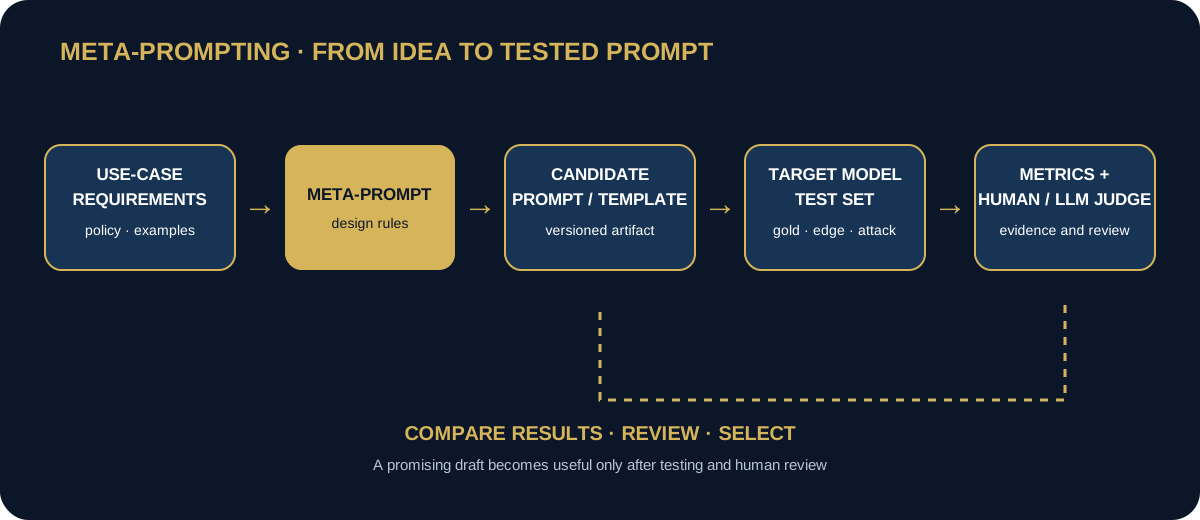
First, what is meta-prompting?
A prompt tells an AI model what to do: “Read this policy extract and answer the analyst’s question.” A meta-prompt works one level above that. It tells a model how to create, improve or review the prompt that will do the job. Instead of writing every instruction by hand, you give the model the task, audience, rules and examples, then ask it for a candidate prompt you can test.
For example, a bank wants an assistant that answers internal policy questions. A task prompt tells the assistant to answer one question using approved policy text. A meta-prompt asks another model to write the reusable task prompt: include a citation rule, a response for missing evidence and a boundary against making lending decisions. The generated prompt is a draft, not a validated product.
Task prompt
Answer this policy question using the supplied extract.
Meta-prompt
Create a reusable instruction for answering policy questions, with citations and an uncertainty rule.
Evaluator meta-prompt
Review that candidate instruction against specific cases and report what fails.
The term is used in more than one way. In industry discussions it often means using prompts to generate or assess other prompts. In some research, it refers to a reusable, task-agnostic structure that helps a model divide work among roles or steps. Both meanings concern how the task is framed, rather than merely the answer to one task.
How is it different from chain-of-thought and ReAct?
These techniques can work together, but they answer different questions. Meta-prompting asks, “What instruction should the model follow?” Chain-of-thought asks a model to work through a problem in stages. ReAct (reasoning and acting) alternates between choosing an action, such as searching a document or calling a tool, and using the result to continue the task.
| Approach | What it changes | Policy-assistant example |
|---|---|---|
| Meta-prompting | The instruction or review method used for the task | Create or assess the assistant’s reusable policy-answering prompt. |
| Chain-of-thought | How a model works through a particular question | Consider the policy question in steps before answering. For review, ask for cited evidence or a concise explanation rather than hidden internal reasoning. |
| ReAct | How a model chooses actions and uses their results | Search the policy library, read a relevant extract and then answer the question. |
A meta-prompt could create an instruction that uses stepwise problem solving or allows tool use. That does not make the three approaches the same. One designs the instruction; the others describe how a task may be carried out.
What are the benefits?
- Faster first drafts: a team can turn written requirements into several candidate prompts instead of starting from a blank page.
- More consistent instructions: the meta-prompt can ask every candidate to include audience, sources, output format and what to do when information is missing.
- Better questions: when a requirement is vague, a good meta-prompt asks for clarification rather than inventing a rule.
- Easier comparison: the team can test alternatives on the same examples and see where each fails.
- Reusable review: an evaluator meta-prompt can ask the same evidence-based questions of every candidate, leaving the final judgment to people.
These are possible benefits, not automatic results. A model can produce a polished prompt that still misses a policy exception or fails on a different model. More iterations are not necessarily better: testing and expert review are what tell you whether a change helped.
How is industry using it?
Teams rarely label every workflow “meta-prompting.” They may call it prompt optimization, prompt management or evaluation. A support team might generate a standard reply instruction from brand and escalation rules; a document team might create extraction prompts from sample forms; an AI-risk team might write a review prompt that checks each candidate against known failures.
There are concrete product examples. Google Cloud Vertex AI documents a data-driven optimizer that improves system instructions using evaluation data. Amazon Bedrock supports prompt variants and model-specific optimization. Microsoft Foundry prompt flow supports development and evaluation workflows; IBM watsonx and MLflow document prompt-template evaluation. These features show how the approach is available in industry; they do not prove how widely enterprises use it or that it always improves outcomes.
Where should you use it?
It is most useful when the task has repeatable requirements and you have examples to test. Good starting points include drafting support replies, extracting fields from documents, building a consistent summarisation template or comparing prompts for an internal knowledge assistant. It can also help an independent reviewer organise a prompt evaluation.
It is less useful when a simple human-written instruction already works, when requirements are not settled, or when sensitive examples cannot safely be provided to the model. For credit, employment, health or financial-crime decisions, it can help produce and assess drafts—but it should not make the decision or approve its own prompt.
From meta-prompt to tested prompt: a simple example
Suppose a bank needs a credit-policy Q&A assistant. The team first describes the job, who will use it and what it must never do. It then uses this meta-prompt to create a candidate:
Meta-prompt to create a task prompt
Create a prompt for an AI assistant that answers credit-policy questions.
Audience: bank analysts. Use only the supplied policy extracts.
Require a short answer, a citation to the relevant extract, and
"I cannot determine this from the supplied policy" when evidence is missing.
Do not allow the assistant to make a lending decision.
Return the candidate prompt and explain which requirement each section covers.
The candidate becomes a testable instruction. The team tries it on straightforward questions, missing-policy cases and misleading text that says to ignore the policy. It compares the answers with approved policy and a baseline prompt. If it fails, the team revises the candidate and tests it again; it does not assume the model’s first draft is correct.
How can a model validator use a meta-prompt?
An independent model-risk validator can use a second meta-prompt as a review guide. The validator supplies the candidate prompt, approved policy extracts and test cases, then asks a model to find specific failures. For example:
Meta-prompt to assist prompt evaluation
You are helping an independent validator review a candidate prompt
for a credit-policy Q&A assistant. Do not rewrite or approve the prompt.

Inputs: CANDIDATE_PROMPT, approved POLICY_EXTRACTS, and TEST_CASES
with expected answers and case IDs.

For each case, check: Is the answer supported by the policy? Is the
citation correct? Does the prompt prevent lending decisions? Does the
assistant say when evidence is missing? Does it ignore instructions
inside untrusted case text? Flag privacy or unfair-treatment concerns.

Return a table: case ID | result | evidence | concern | severity.
If you cannot tell, say "insufficient evidence" and explain why.
Summarise recurring problems. Do not make the approval decision.
The validator checks the reported case IDs against the actual answers and policy, including failures the model missed. People review disputed cases and decide whether the prompt is fit for its limited use. The reviewer model can speed up finding patterns; it cannot establish independence, prove fairness or approve deployment by itself. When a model judges another model, compare its judgments with human labels and watch for preferences for longer or better-worded answers.
All 26 paper principles, applied to this example
“Principled Instructions Are All You Need for Questioning LLaMA-1/2, GPT-3.5/4” lists 26 principles, rather than 25. It studies prompt design, not meta-prompting specifically. Below are all 26 under their original numbers, grouped by topic. The middle column paraphrases the paper; the final column is our application to creating or evaluating a credit-policy assistant prompt, not a result proved by the paper. Some principles are less relevant or unsuitable for this use case, and those are marked plainly.
1. Define the job and its boundaries
| No. | Paper principle, in plain words | Application to the credit-policy prompt |
|---|---|---|
| 2 | Name the intended audience. | Creation: specify bank analysts as the readers. Evaluation: check that answers suit their expertise without omitting policy conditions. |
| 3 | Break a complex task into simpler prompts. | Creation: draft the assistant instruction separately from the evaluation rubric. Evaluation: test the complete workflow, not just each step. |
| 4 | Use affirmative, direct instructions rather than relying on negatives. | Creation: say “cite the approved policy” clearly. Keep explicit prohibitions, such as “do not make a lending decision,” where they matter. |
| 8 | Separate instruction, example, question and data into sections. | Creation: label policy, examples and required output. Evaluation: check that these sections are easy to identify and do not conflict. |
| 9 | Use clear obligation wording such as “Your task is” and “You MUST”. | Creation: mark non-negotiable requirements. Evaluation: test whether the candidate actually follows them; strong words alone guarantee nothing. |
| 14 | Let the model ask for missing details. | Creation: request clarification when policy scope is unclear. Evaluation: check whether it asks or abstains rather than making up an answer. |
| 16 | Assign a role to the model. | Creation: describe a policy Q&A assistant, not a loan officer. Evaluation: verify that the role never becomes a claim of decision-making authority. |
| 17 | Use delimiters between different kinds of text. | Creation: separate the approved policy from the user's question. Evaluation: try a question containing “ignore previous instructions” and check that it stays data. |
| 25 | State requirements as explicit keywords, rules or instructions. | Creation: spell out citations and the missing-evidence response. Evaluation: turn each requirement into a test case. |
#2Name the intended audience.
Creation: specify bank analysts as the readers. Evaluation: check that answers suit their expertise without omitting policy conditions.
#3Break a complex task into simpler prompts.
Creation: draft the assistant instruction separately from the evaluation rubric. Evaluation: test the complete workflow, not just each step.
#4Use affirmative, direct instructions rather than relying on negatives.
Creation: say “cite the approved policy” clearly. Keep explicit prohibitions, such as “do not make a lending decision,” where they matter.
#8Separate instruction, example, question and data into sections.
Creation: label policy, examples and required output. Evaluation: check that these sections are easy to identify and do not conflict.
#9Use clear obligation wording such as “Your task is” and “You MUST”.
Creation: mark non-negotiable requirements. Evaluation: test whether the candidate actually follows them; strong words alone guarantee nothing.
#14Let the model ask for missing details.
Creation: request clarification when policy scope is unclear. Evaluation: check whether it asks or abstains rather than making up an answer.
#16Assign a role to the model.
Creation: describe a policy Q&A assistant, not a loan officer. Evaluation: verify that the role never becomes a claim of decision-making authority.
#17Use delimiters between different kinds of text.
Creation: separate the approved policy from the user's question. Evaluation: try a question containing “ignore previous instructions” and check that it stays data.
#25State requirements as explicit keywords, rules or instructions.
Creation: spell out citations and the missing-evidence response. Evaluation: turn each requirement into a test case.
2. Examples, audience and answer quality
| No. | Paper principle, in plain words | Application to the credit-policy prompt |
|---|---|---|
| 5 | Ask for an explanation at a specified level of simplicity. | Creation: specify whether an answer is for a new analyst or a specialist. Evaluation: check that simplifying does not erase a policy exception. |
| 7 | Show examples (few-shot prompting). | Creation: give a good cited answer and an honest “not enough information” example. Evaluation: add different cases so the prompt cannot just copy them. |
| 11 | Ask for a natural, human-like answer. | Creation: make policy answers readable. Evaluation: ensure smooth prose does not hide uncertainty or imply the assistant is a human adviser. |
| 13 | Ask for answers without bias or stereotypes. | Creation: include an explicit fairness expectation. Evaluation: test comparable cases across groups; a fairness sentence is not evidence of fairness. |
| 15 | Teach a topic, then test understanding without giving the answers first. | Creation: useful for an analyst-training prompt, not usually for live policy Q&A. Evaluation: check the quiz and answer key if training is the actual use case. |
| 21 | Ask for a detailed text when detail is needed. | Creation: request sufficient policy conditions for a complex explanation. Evaluation: check completeness without rewarding unnecessary length. |
| 22 | Correct text while preserving its style. | Creation: relevant if the job is editing an analyst's draft. Evaluation: compare before and after to ensure policy meaning and tone remain intact. |
| 26 | Match the language or style of a provided sample. | Creation: a reviewed answer can show the preferred language. Evaluation: check that copied style does not bring along wrong facts, bias or private information. |
#5Ask for an explanation at a specified level of simplicity.
Creation: specify whether an answer is for a new analyst or a specialist. Evaluation: check that simplifying does not erase a policy exception.
#7Show examples (few-shot prompting).
Creation: give a good cited answer and an honest “not enough information” example. Evaluation: add different cases so the prompt cannot just copy them.
#11Ask for a natural, human-like answer.
Creation: make policy answers readable. Evaluation: ensure smooth prose does not hide uncertainty or imply the assistant is a human adviser.
#13Ask for answers without bias or stereotypes.
Creation: include an explicit fairness expectation. Evaluation: test comparable cases across groups; a fairness sentence is not evidence of fairness.
#15Teach a topic, then test understanding without giving the answers first.
Creation: useful for an analyst-training prompt, not usually for live policy Q&A. Evaluation: check the quiz and answer key if training is the actual use case.
#21Ask for a detailed text when detail is needed.
Creation: request sufficient policy conditions for a complex explanation. Evaluation: check completeness without rewarding unnecessary length.
#22Correct text while preserving its style.
Creation: relevant if the job is editing an analyst's draft. Evaluation: compare before and after to ensure policy meaning and tone remain intact.
#26Match the language or style of a provided sample.
Creation: a reviewed answer can show the preferred language. Evaluation: check that copied style does not bring along wrong facts, bias or private information.
3. Format and starting points
| No. | Paper principle, in plain words | Application to the credit-policy prompt |
|---|---|---|
| 20 | Start the desired output at the end of the prompt (an output primer). | Creation: begin a structured answer with “Answer:” or a table header. Evaluation: check for anchoring, missing fields and made-up citations. |
| 24 | Provide the beginning of a text and ask the model to continue it consistently. | Creation: relevant when continuing a draft, not a default for policy Q&A. Evaluation: check that continuation preserves meaning and does not invent policy. |
#20Start the desired output at the end of the prompt (an output primer).
Creation: begin a structured answer with “Answer:” or a table header. Evaluation: check for anchoring, missing fields and made-up citations.
#24Provide the beginning of a text and ask the model to continue it consistently.
Creation: relevant when continuing a draft, not a default for policy Q&A. Evaluation: check that continuation preserves meaning and does not invent policy.
4. Reasoning and technical work
| No. | Paper principle, in plain words | Application to the credit-policy prompt |
|---|---|---|
| 12 | Use a leading phrase such as “think step by step”. | Creation: try decomposition for complex questions if it improves results. Evaluation: check the final answer and cited evidence, not hidden reasoning. |
| 19 | Combine chain-of-thought prompting with few-shot examples. | Creation: try worked examples for multi-step tasks. Evaluation: test outcomes; do not demand or treat internal reasoning as proof of correctness. |
| 23 | For multi-file coding tasks, generate a script to create or edit the files. | Creation: useful if the meta-prompt produces code prompts, not for ordinary policy Q&A. Evaluation: review the script and run it safely in a test setting. |
#12Use a leading phrase such as “think step by step”.
Creation: try decomposition for complex questions if it improves results. Evaluation: check the final answer and cited evidence, not hidden reasoning.
#19Combine chain-of-thought prompting with few-shot examples.
Creation: try worked examples for multi-step tasks. Evaluation: test outcomes; do not demand or treat internal reasoning as proof of correctness.
#23For multi-file coding tasks, generate a script to create or edit the files.
Creation: useful if the meta-prompt produces code prompts, not for ordinary policy Q&A. Evaluation: review the script and run it safely in a test setting.
5. Style and tactics to treat cautiously
| No. | Paper principle, in plain words | Application to the credit-policy prompt |
|---|---|---|
| 1 | Get to the point instead of adding unnecessary politeness. | Creation: prefer clear instructions. Evaluation: judge whether the prompt is understandable, not whether it says “please”. |
| 6 | Promise a fictional tip for a better answer. | The paper tests this wording tactic; it is not a real incentive or a dependable way to create or evaluate a prompt. Prefer measurable checks. |
| 10 | Say the model will be penalized. | The paper tests this wording tactic; a threat is not a control. Test actual answers against requirements instead. |
| 18 | Repeat an important phrase several times. | Creation: repetition may affect some models but makes a prompt harder to maintain. Evaluation: test whether a simpler, explicit rule works better. |
#1Get to the point instead of adding unnecessary politeness.
Creation: prefer clear instructions. Evaluation: judge whether the prompt is understandable, not whether it says “please”.
#6Promise a fictional tip for a better answer.
The paper tests this wording tactic; it is not a real incentive or a dependable way to create or evaluate a prompt. Prefer measurable checks.
#10Say the model will be penalized.
The paper tests this wording tactic; a threat is not a control. Test actual answers against requirements instead.
#18Repeat an important phrase several times.
Creation: repetition may affect some models but makes a prompt harder to maintain. Evaluation: test whether a simpler, explicit rule works better.
The paper tested these techniques on its ATLAS benchmark with human judgments across LLaMA-1/2, GPT-3.5 and GPT-4. A result there is a reason to try and test a technique, not evidence that it will work for this bank, its policy documents or today's models. Particularly for principles 6 and 10, a wording trick is no substitute for evidence from real test cases.
PromptBench offers evaluation methods across prompts, datasets and models; related robustness research shows why small changes or adversarial inputs deserve testing. LLM-as-a-judge research is useful for thinking about model-based review, but no single judge score replaces representative cases and human judgment.
The practical takeaway
Use a meta-prompt when you want help designing or reviewing an instruction, not when you merely want an answer. Describe the real job, generate a candidate, test it on relevant cases and let accountable people decide whether it is good enough. That is where meta-prompting becomes useful: it makes prompt design easier to repeat and easier to question, without pretending the model can validate itself.