1. What is caching—and why does it help?
Caching stores a reusable result or intermediate computation so a later request can avoid doing the same work again. It is an optimization layer, not the authoritative source of truth. A database may own the business record; a cache holds a copy or derived artifact that is valid only under defined conditions.
A cache hit means a suitable stored item is found and passes the checks needed for reuse. A cache miss means the system must perform the normal work. On a miss, it may store an eligible result for future requests. Entries can expire after a time-to-live (TTL), be invalidated when their dependencies change, or be evicted when storage is full. These are different events: an entry can still be present and unexpired but no longer be correct.
Traditional software often caches a database query or HTTP response. AI systems have more expensive stages: parsing documents, creating embeddings, searching knowledge, processing long model inputs and generating output tokens. Caching helps by avoiding one or more of these stages—not necessarily the entire workflow.
Where does the cache fit in an AI request?
One workflow, several opportunities to reuse work
- Before model invocation: exact or semantic response-cache lookup can find a complete answer and avoid generation.
- During data preparation and retrieval: reuse parsed text, embeddings, search results or authorized read-only tool results.
- Inside model serving: prompt-prefix caching reuses input computation, while the model still generates a new response.
For a generated response, latency roughly includes authorization, retrieval/tools, model input processing, output generation and network overhead. A response cache may skip much of the downstream path. A prompt cache primarily reduces repeated input processing. This is why two techniques both called “caching” can have very different effects on response time and token charges.
Three questions make the design clear
What is stored? What must match for reuse? Which expensive stage is avoided? Then ask whether the stored item is still correct and authorized for this request.
2. The main caching types in AI—and why they differ
A cache stores something expensive to recreate. In an LLM workflow, that “something” might be a complete answer, a model’s input computation, a document embedding or a database read. These save different kinds of work.
| Cache | What is reused | LLM generation? | Main condition |
|---|---|---|---|
| Prompt / prefix cache | Unchanged model input prefix and its computation | Yes: new suffix and output | Exact prefix; provider eligibility and retention |
| Exact-response cache | A previously validated complete answer | No, on a safe hit | Same relevant request context, versions and access scope |
| Semantic-response cache | An answer to an equivalent, differently worded request | No, on a safe hit | Similarity + answer-equivalence and metadata checks |
| Embedding / preprocessing cache | Vectors, parsed text, OCR or other derived artifacts | Usually yes, for the final answer | Content hash + processing / model version |
| Retrieval cache | Authorized document IDs, snippets or ranked results | Usually yes, for generation | Query, filters, corpus version and current permissions |
| Read-only tool-result cache | A reusable API / database read result | Depends on the workflow | Freshness window, entity, arguments and authorization |
In-memory, distributed, hybrid and edge caching describe where a cache lives. Exact matching and semantic matching describe how a reusable item is found. A distributed cache can support either. A vector database can help find semantic candidates, but it does not decide whether serving an answer is safe.
AI introduces a particular difficulty: similar wording does not guarantee an equivalent answer. Context, permissions, source versions and user intent all matter. Exact-response caching is still useful when full requests genuinely repeat; semantic caching can extend reuse to safe paraphrases, not replace correctness checks.
A terminology note: some tutorials use “prompt caching” broadly for storing prompt–answer pairs. DataCamp’s dictionary-based example is an application-level response cache; the supplied TrueFoundry comparison also uses an exact-match response-cache meaning. In this article, prompt caching means provider/model-side prefix reuse, and response caching means storing the generated answer. This distinction follows provider documentation and avoids confusing two different mechanisms.
3. Prompt caching: avoid processing the same prefix again
At the model-serving layer, prompt caching means reusing computation for an unchanged beginning of the input. To understand why it helps, distinguish two parts of inference:
- Prefill: the model processes the input and builds attention key/value (KV) states representing earlier tokens.
- Decode: the model generates new output tokens, using those states and updating them as generation progresses.
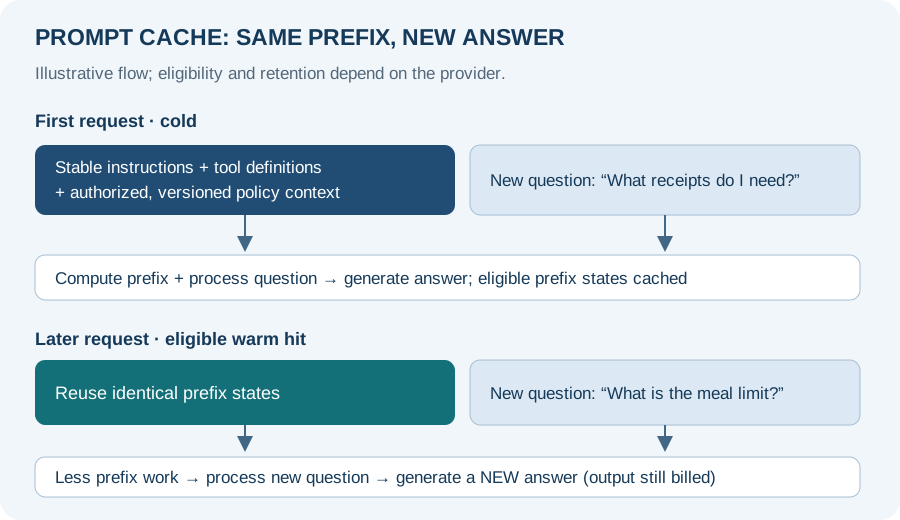
Prompt-prefix caching preserves eligible states across requests. A later request with a matching prefix can reuse those states instead of recomputing that input block. The provider still processes new input and runs decoding to produce a new answer. The ordinary KV cache used during one generation is related machinery; cross-request prefix reuse is the optimization being discussed here.
Example: the same policy, different questions
Consider an assistant with a long approved policy bundle, stable instructions and tool schemas. One request asks which receipts are required; another asks about the meal limit. Their answers differ, but their shared beginning can match. Put stable authorized content before the changing question, where the API’s structure allows. The prefix must match exactly; the entire request does not need to be identical.
What happens to tokens and latency?
Prompt caching does not shorten the logical prompt or remove its tokens from the context window. In implicit caching, the application may still send the full input; explicit managed-context APIs can instead reference stored content. On a hit, eligible tokens are accounted for under the provider’s cache-read behavior, often at a lower input rate. The changing suffix and newly generated output remain chargeable under the applicable pricing.
For example, an 8,000-token stable prefix plus a 2,000-token new suffix still represents 10,000 input tokens. A full-prefix hit may let 8,000 use cached-input pricing and leave 2,000 as fresh input. If the model generates 1,000 output tokens, those are still new output. Less repeated computation and cheaper input are not the same as fewer context tokens or zero output cost. Rate-limit treatment is also provider-specific.
How to make it work
- Keep the reusable beginning stable. Avoid putting a fresh timestamp, random identifier or changing user question before a large shared block.
- Use provider-supported controls. Follow the model’s automatic caching, explicit breakpoint or managed-context mechanism. Minimum token counts, lifetimes and supported content vary.
- Preserve correctness over hit rate. Update a changed policy even if that causes a miss. Do not rearrange messages in a way that changes their meaning, trust boundary or permissions.
- Verify reuse from usage telemetry. Inspect cached-input tokens and creation/read usage where available; repeated requests alone do not prove a hit.
This can reduce prefill latency—the work before generating tokens—and time to first token. It does not automatically speed up every output token. A response dominated by long generation, slow tools or retrieval may show a smaller end-to-end improvement.
Trade-off: writes, storage or retention can cost money, depending on the provider. Short or infrequently repeated prefixes may not qualify or pay back their setup cost. Self-hosted prefix caching also consumes limited accelerator memory and interacts with scheduling and eviction; it is not unlimited free capacity.
4. Semantic caching: reuse an answer when the meaning and context match
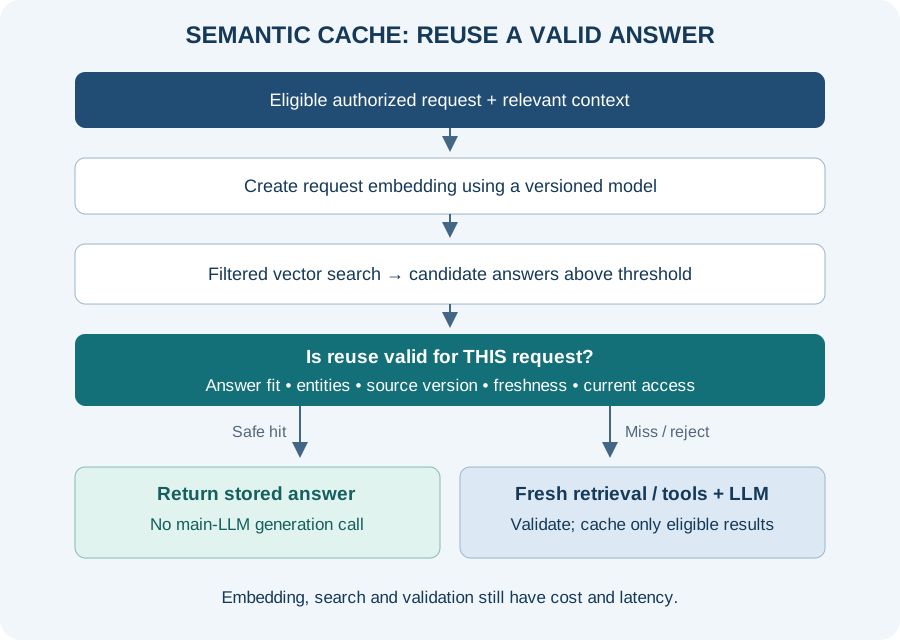
Semantic response caching stores previously validated answers and finds candidates by meaning rather than identical wording. It usually operates in the application or gateway before the generation-model call. Unlike prompt caching, a safe semantic hit returns an existing answer instead of asking the model to generate a new one.
The technical flow
- Check eligibility and scope. Authorize the user and determine whether this intent is safe for response reuse.
- Embed the request. Produce a vector representation of the question and the relevant context using a versioned embedding model.
- Search stored candidates. Apply tenant, policy/source-version and other context filters to a vector index. Compare candidates using the configured distance or similarity metric.
- Evaluate the match. A threshold identifies close candidates; structured entity, freshness, current permission and answer-coverage checks decide whether reuse is actually valid.
- Serve or fall back. Return an approved answer on a safe hit. Otherwise execute the authorized fresh workflow, validate the new answer and cache it only if eligible.
A practical entry holds the request representation, embedding/model version, answer, supporting evidence, source/context versions, access scope and expiry. A vector-search-capable store such as Redis, Qdrant or PostgreSQL with an appropriate extension can support the lookup. The database supplies candidate search—not a guarantee of answer equivalence.
Example: different wording, potentially the same answer
“Which documents must I attach to a domestic travel claim?” and “What supporting paperwork is required for domestic travel reimbursement?” may be equivalent under the same policy. But “Can I claim meals with a receipt?” and “Can I claim meals without a receipt?” can have very similar embeddings and very different answers.
Potentially reusable
Same intent, same policy version, same region, same eligibility and no private claim-specific context. Validate the candidate’s coverage and evidence before serving.
Reject the apparent match
Different amount, missing receipt, another employee’s claim, changed policy, time-sensitive status or a request to take an action. Similar wording is not enough.
Filter by tenant, current access scope, language, policy version and relevant structured entities. Check expiry and whether the candidate actually covers the requested facts. For sensitive domains, prefer deterministic eligibility rules and narrow cacheable intents; if equivalence is uncertain, use the fresh path. Adding a second LLM to validate every hit can consume much of the intended saving.
Threshold tuning is an evaluation problem. A lower threshold can increase hit rate and false hits. A higher one can reject useful paraphrases. There is no universally safe “0.85”: scores depend on the embedding model, distance metric, dataset and index. Test accepted matches, near misses and clearly unrelated requests separately.
What happens to tokens and latency?
On a safe hit, the main generation LLM is not called, so that request avoids its new input-processing and output-generation token usage. The user still receives the stored answer’s text; it is not regenerated. Embedding tokens, lookup infrastructure and any model-based classification or validation can still incur charges. A miss incurs lookup overhead and the normal generation work.
This can reduce total response time more broadly than prefix reuse because the hit skips generation. It is not instant or free: authorization, embedding, search, validation and network delivery still take time. If hits are rare, or validation is as expensive as a fresh answer, semantic caching can make the workload slower or more costly.
Trade-off: embedding, vector search and validation add cost and latency, especially on misses. Changing the embedding model requires re-embedding or partitioning the index by version; changing policies or generation behavior requires reviewing or invalidating affected cached answers. Semantic caching is not a replacement for RAG or an authoritative database.
5. Prompt versus semantic caching: where to use which
| Question | Prompt-prefix caching | Semantic-response caching |
|---|---|---|
| What is stored? | Reusable model input states / provider-managed context | A validated answer, request embedding and metadata |
| Where does it run? | Inside supported model serving | Before generation, in the application / gateway |
| What must match? | An eligible unchanged rendered input prefix | Answer-equivalent intent plus relevant context and scope |
| Is a new answer generated? | Yes; every request still decodes output | No on a safe hit; yes on a miss |
| What is saved? | Repeated prefill work; eligible input may have lower rates | Main generation-model input and output usage on hits |
| When does it fit? | Long stable context with questions that may require different answers | Repeated low-risk intents that can safely share an answer |
| Main trade-off? | Prefix misses, retention, write/storage cost and memory capacity | False hits, stale answers, privacy and lookup/validation overhead |
They are complementary, not competing substitutes. A semantic hit can bypass the generation model. A semantic miss can still use prompt-prefix caching when it reaches the model. Paraphrasing the question may not affect a stable shared prefix, so it is incorrect to say provider prompt caching cannot help requests with differently worded questions.
Putting it together: an employee travel assistant
An assistant helps employees understand policy, prepare receipts and follow up on claims. I would choose the cache according to the stage and the required freshness:
- Many different questions over the same policy: use prompt caching for stable instructions, tool schemas and the authorized policy prefix. Each question still gets a new answer.
- The same general receipt question in different words: consider semantic response caching, but only within matching policy, region, access and eligibility constraints.
- The identical FAQ request and context repeated: exact-response caching may be simpler and cheaper than embedding-based search.
- The same receipt uploaded again: reuse parsing/OCR or embedding artifacts keyed by content and processing versions.
- “Has my claim been paid?”: read the current authorized financial record. Do not reuse another employee’s answer; cache only if an explicit per-entity freshness contract allows it.
- “Submit this claim” or “release payment”: follow the controlled action and approval path. A cached answer must not execute or authorize the operation.
The same distinction generalizes beyond travel: document analysis with new questions often benefits from stable-prefix reuse; repeated approved product FAQs may suit semantic caching; live order status and high-impact decisions need current data and stronger controls.
6. How the other caches fit around these two
Exact-response caching
An application-level exact cache reuses a complete validated answer for the same relevant request context. It is closer to semantic caching in what it stores, but different in how it finds a hit: a deterministic key rather than an embedding similarity search.
A practical key covers the request, relevant conversation state, tenant/access scope, source/policy version, prompt version, model identity and answer-affecting settings. Use canonical serialization and a cryptographic hash to avoid ambiguous concatenation. A hash is not encryption or anonymization; cached payloads still need protection.
Trade-off: broad keys can mix contexts; narrow keys reduce hits. Do not normalize away negation, amounts, dates, currencies or entity IDs. Reusing a stored output is also inappropriate when the user explicitly wants a fresh creative variation.
Embedding, retrieval and tool caches
- Parsing and embeddings: reuse OCR results and document vectors keyed by content hash plus extraction, chunking and embedding versions. A changed receipt, parser or embedding model needs a different artifact.
- RAG retrieval: cache expensive searches for a query, filters and corpus/index version. Store source IDs and provenance; recheck access and current source validity before reuse. A retrieval hit usually still leads to generation.
- Read-only tools: cache slowly changing reference data, such as an approved category list. Live exchange rates, balances or claim status need freshness guarantees suited to the business—not a blanket long TTL.
- Agent substeps: reuse stable classification or planning inputs only when state, tool availability and constraints still match. Reusing an old plan after the world changes can produce the wrong action.
A local in-process cache is fast but separate across instances and lost on restart. A distributed key-value cache shares results across replicas but adds a network hop, operational cost and concurrency concerns. A semantic layer needs vector search and filterable metadata. Combine layers only when their added complexity is justified.
Do not cache action execution as if it were reusable knowledge. Claim submission and payment require durable transaction controls and idempotency. An idempotency key prevents one operation from being executed twice; it does not authorize replaying a different person’s result or skipping a new approval.
7. Put the layers into a safe architecture
The order matters. Authenticate and classify first. Check response caches only for eligible requests. Treat exact and semantic hits as candidates that must pass current access, freshness and validity checks. On a miss or rejected candidate, retrieve authorized evidence, call required tools and generate a new response—with provider prefix reuse where applicable.
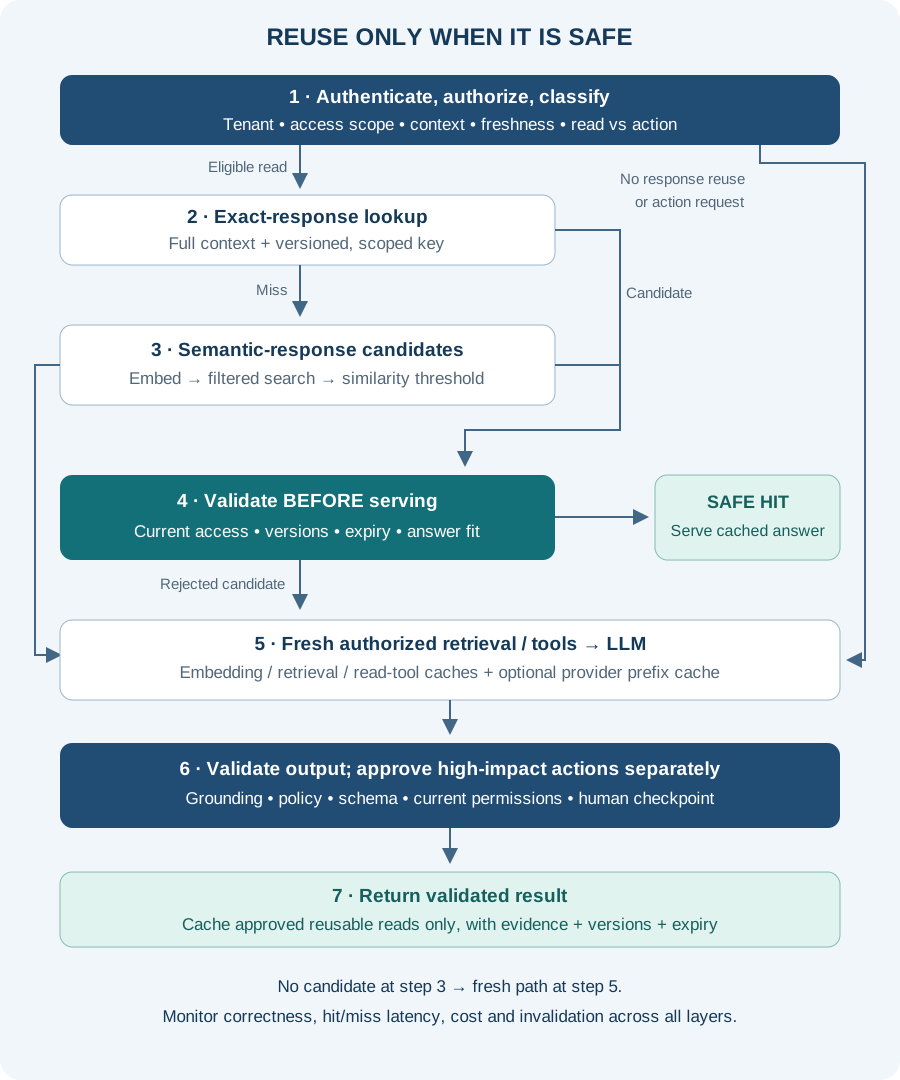
Validate grounding, required output schema and business rules before admitting a response to the cache. Store evidence, source versions, eligibility metadata, expiry and generation configuration with approved entries. A cached answer must retain its supporting citations—not just fluent text.
If the cache service fails, a bounded bypass to the normal authorized workflow can preserve availability. It must not bypass security checks. Protect the fallback from overload with timeouts, rate limits and circuit breakers. On popular misses, use request coalescing or bounded locks to avoid a cache stampede: many callers generating the same missing result at once.
8. Connect caching to token costs and response time
Prompt caching reduces the cost of eligible input
A 90% discount on cached input is not a 90% reduction in total application cost. Uncached input, output generation, cache writes, storage, embeddings, retrieval, tools and validation still matter.
Illustrative prompt-cache calculation
Fictional rates, not a provider quote: input $2 / million tokens; cached input $0.20 / million; output $8 / million. Assume 8,000 reusable input tokens, 2,000 new input tokens and 1,000 output tokens.
- Without a cache hit
- 10,000 × $2 / 1M + 1,000 × $8 / 1M = $0.028
- With an eligible warm prefix hit
- 8,000 × $0.20 / 1M + 2,000 × $2 / 1M + 1,000 × $8 / 1M = $0.0136
That is about 51% lower model cost for this warm request, not 90%. The example excludes cache creation, storage and other workflow costs and assumes equal output length. Cold requests and partial hits change the average.
Semantic caching can avoid both generation input and output
Consider a separate, illustrative batch of 100 requests, each otherwise using 10,000 generation-model input tokens and 1,000 output tokens. Without response reuse, that is 1,000,000 input and 100,000 output tokens. If 60 requests are validated semantic hits, only the 40 misses need fresh generation: 400,000 input and 40,000 output tokens for the main LLM.
That is 60% less main-model token usage under these assumptions—not a predicted hit rate or 60% lower total system cost. Embeddings, lookup, validation and cache operations remain. If the fresh path also uses prompt caching, price its cached and uncached input separately; do not count the same avoided work twice.
Latency follows the stage that is skipped
- Prompt-cache hit: authorization/retrieval + reduced prefill + new output generation + delivery. First-token latency can improve; long decoding or tools can still dominate completion time.
- Semantic-cache hit: authorization + embedding + search + reuse validation + stored-answer delivery. No main-LLM prefill or decoding is needed unless the application deliberately adds another generation step.
- Semantic-cache miss: lookup overhead + the normal fresh workflow. Measure this path too; a fast hit does not guarantee a fast overall system.
For response caching, estimate the average as lookup cost + hit rate × hit-validation cost + miss rate × fresh-path cost + amortized write/storage cost. Include embeddings and equivalence checks in the appropriate path. Exact and semantic hits are sequential, not percentages to add together: a semantic lookup sees only requests not already served by the exact cache.
For prompt caching, break-even depends on how often a prefix is reused before expiry and the model’s write/read/storage pricing. Measure actual token usage and bills rather than assuming every eligible request hits.
Track time to first token, total completion time and p50/p95 latency separately, split by cache layer, cold/warm state and hit/miss. A high hit rate can coexist with slow misses or unacceptable false hits. The business metric is cost per correct, authorized completed task—not cost per response alone.
9. What the industry is doing—and what the evidence means
Two distinct approaches are visible in current documentation: providers reuse input computation inside model serving, while application platforms and AI gateways reuse selected responses and intermediate results outside the model. They can work together; they should not be described as the same mechanism.
OpenAI
Documents prompt-prefix reuse on supported models. Automatic behavior, explicit controls, eligible lengths, retention and pricing vary by model/API. Verify cached-input usage rather than assuming a hit.
Anthropic
Documents automatic and explicit cache-control mechanisms for supported Claude models. Prefix structure and breakpoints matter; cache writes and reads can have different rates, and duration options vary.
Google Gemini
The generateContent documentation covers implicit reuse and explicit cached-content resources with a lifetime. Explicit caching includes storage-duration cost. Support differs across models and API surfaces.
Application gateways
Oracle describes exact, prompt and semantic caching; TrueFoundry and Tetrate discuss response reuse and gateway-level controls. Centralization can help with policy and telemetry, but tenant isolation and answer validity still need explicit design.
LogicMonitor reports that a semantically similar repeat request had 50% lower response time in a controlled Catchpoint lab test. That is a vendor-reported result for that test, not a forecast for every enterprise workflow. Real gains depend on repetition, lookup overhead, output length, data change frequency and the correctness standard.
Published lists also mix storage placement, response matching and compute optimizations. Keep these categories separate. Quantization, autoscaling and federated learning are not themselves semantic or prompt caching. Likewise, an “80% savings” headline is not a production guarantee.
10. Production checklist: correctness before hit rate
Build a representative evaluation set before enabling broad reuse. Include genuine paraphrases and difficult negative pairs: changed amounts, negation, region, dates, employee IDs, follow-up pronouns and policy versions. Compare cached and uncached paths against approved expected behavior—not just matching text.
- Define cacheable intents. Start with stable, low-risk reads. Exclude dynamic or personalized results unless their freshness and identity constraints can be enforced.
- Version dependencies. Track source, prompt, model, embedding, schema and tool versions as applicable. Invalidate on meaningful changes; do not rely only on a TTL.
- Recheck authorization. Test cross-tenant isolation, revoked roles, deleted sources and account changes. A cache entry never grants access.
- Protect data and writes. Restrict cache admission to validated trusted results; defend against cached prompt-injection content and poisoned answers. Minimize PII and enforce encryption, retention and deletion across replicas and backups as required.
- Measure quality. Track false-hit rate, accepted-hit correctness, grounding, stale responses and task success. Similarity scores are diagnostic signals, not accuracy scores.
- Measure performance and spend. Compare cold, warm, hit and miss paths; include provider usage, embedding/search fees, storage, validation and infrastructure.
- Exercise failure modes. Test expiry, eviction, cold starts, stampedes, network failures, missing citations and embedding-model changes. Bound fallback traffic.
- Roll out gradually. Use shadow evaluation or sampled fresh-path comparisons with appropriate privacy and cost controls. Set risk-based thresholds, an owner, alerts and a cache-disable switch.
The practical takeaway
Use prompt caching for stable input processing. Use exact-response caching for truly equivalent requests. Add semantic caching only where answer equivalence can be evaluated and enforced. Cache supporting work where it helps. A faster stale answer is not an optimization—it is a system failure.